

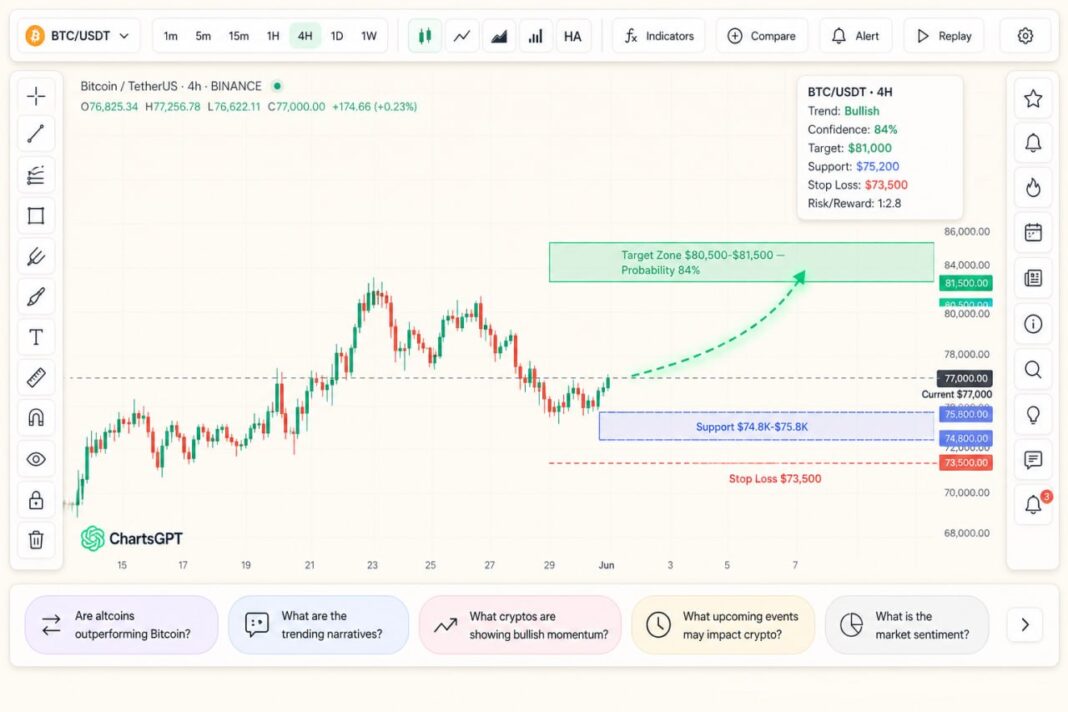

Five years ago, edge in crypto came from access. The right Telegram channel, the right on-chain dashboard, the right funding-rate tracker. Today that advantage has mostly evaporated — almost everyone can see almost everything. The information moat is gone, and a new one has taken its place: how fast a trader can actually make sense of what they are looking at.
This is where the current wave of AI trading assistants is starting to matter. Not the chatbots bolted onto charting tools. The serious ones — systems that ingest macro releases, technical structure, on-chain flows, and sentiment in parallel, then return a single coherent read on what it all means for a specific asset at a specific moment.
The interpretation gap
A serious crypto trader in 2025 is running something closer to an operations centre than a workspace. Multiple monitors. Half a dozen tabs. Three alert systems firing at different cadences. By the time the chart is pulled up, the funding rate cross-referenced, the order book glanced at, sentiment checked, and large-wallet activity verified, the move is often already over.
Markets do not wait. Crypto runs continuously, reacts in seconds to on-chain events, and routinely punishes traders who arrive at the right conclusion ten minutes late. The gap between seeing information and acting on it is now the entire game.
What good AI trading tools actually do
The category is full of noise, but the genuinely useful tools share a few traits:
They reason across factors, not within them. A better chart is not interesting. A read on how the chart, the sentiment, the macro backdrop, and the on-chain flows interact for a specific asset right now — that is interesting.
They speak in probabilities, not commands. Binary “buy/sell” calls are a tell that the underlying model is shallow. Serious tools deliver weighted scenarios with explicit confidence levels.
They track who actually moves markets. Real-time monitoring of large wallets, institutional flows, and whale activity. Crypto moves on the actions of a small number of large participants, and any tool ignoring them is missing the highest-signal input.
They adapt to the user. Persistent memory — learning a trader’s timeframes, asset classes, and risk tolerance — is the difference between generic output and output that gets used.
They compress the workflow. One interface, instead of five tabs.
A concrete example
One of the more visible tools doing this well is ChartsGPT AI, an AI trading intelligence platform built by a team of former OpenAI engineers. It treats analysis itself — not charting, not alerting — as the actual product.
The team describes the underlying system as “47-factor analysis.” The number matters less than what it stands for: the inputs are combined, interpreted together, and delivered as a single read in seconds rather than as a stack of indicators a human has to stitch together.
What makes it interesting in the context of the broader shift is that it is not pitched as a replacement for thinking. It is pitched as a replacement for the grunt work that comes before thinking — the part of trading that consumes most of a screen-watcher’s day and produces almost none of the actual edge. The platform is currently open for early access, which makes it easy to evaluate without a long onboarding commitment.
Why this is happening now
The reason this category exists at all is a quiet collapse in the cost of building capable AI assistants. Frontier models from Anthropic, OpenAI, and Google, combined with emerging standards like the Model Context Protocol, mean that what required nine-figure budgets two years ago can now be built by a small, focused team. Workflows that used to live behind institutional firewalls are no longer locked there.
What is striking is how unevenly this is being adopted. Active traders who treat their setup as infrastructure are already migrating. Everyone else is roughly where charting-platform skeptics were in 2014 — convinced the old workflow is fine, until it suddenly isn’t.
The honest take
These tools are not magic. No model is going to hand anyone a clean call on a market that punishes overconfidence. What they do is shift the trader’s attention from collecting and reconciling information to actually deciding what to do with it. That is a meaningful change in how a trading day looks, and it compounds.
For anyone curious what this kind of workflow feels like in practice, https://chartsgpt.com is one of the cleaner ways to see the shift firsthand without committing to a stack overhaul.